Specialty Billing Company Drops Denial Rate from 9.1% to 3.4%

At a payer contract review, BCBS told Sussex Specialty Billing they were in the bottom decile on denial rate. The contract was up for renegotiation. The practice’s primary specialty payer was effectively warning them.
Business Challenges
The annual payer review meeting with BCBS happened in October 2024. The Sussex Specialty Billing operational team, a 28-provider GI and cardiology practice in the Midwest, was used to the meeting being routine.
The BCBS regional medical director laid out a payer scorecard. Sussex’s denial rate was 11.2%, the bottom decile across BCBS’s network. The clean claim rate was 89%. Sussex’s reimbursement-to-cost ratio was 6 points below the network median.
The medical director didn’t threaten the contract directly, but the framing was unmistakable. The contract was up for renegotiation in twelve months. Sussex’s performance would inform the negotiation. The implicit message: clean up the operations or expect terms to compress.
The COO of Sussex went back to her revenue cycle team. The denial-rate situation was bad for reasons the team understood individually but had never been confronted as a system. Cardiac catheterization lab cases were generating denials at twice the rate of GI procedures because of medical-necessity documentation gaps.
The charge entry was running 3.1 days post-encounter due to coder review queue depth. Net collection rate sat at 92% — well below the 96% specialty benchmark. The refund queue was building because of payer recoupments on previously paid claims.
- BCBS payer scorecard placed Sussex in the bottom decile on denial rate; contract renegotiation in 12 months created a deadline.
- Overall denial rate ran 11.2%; cath lab cases ran 18% denial rate due to medical-necessity documentation gaps.
- Charge entry took 3.1 days post-encounter; coder review queue depth was the bottleneck.
- Net collection rate sat at 92% — 4 points below the 96% specialty benchmark.
- Refund queue was growing as BCBS and three other payers issued recoupments on previously paid claims, often without coordinated notice.
Solution
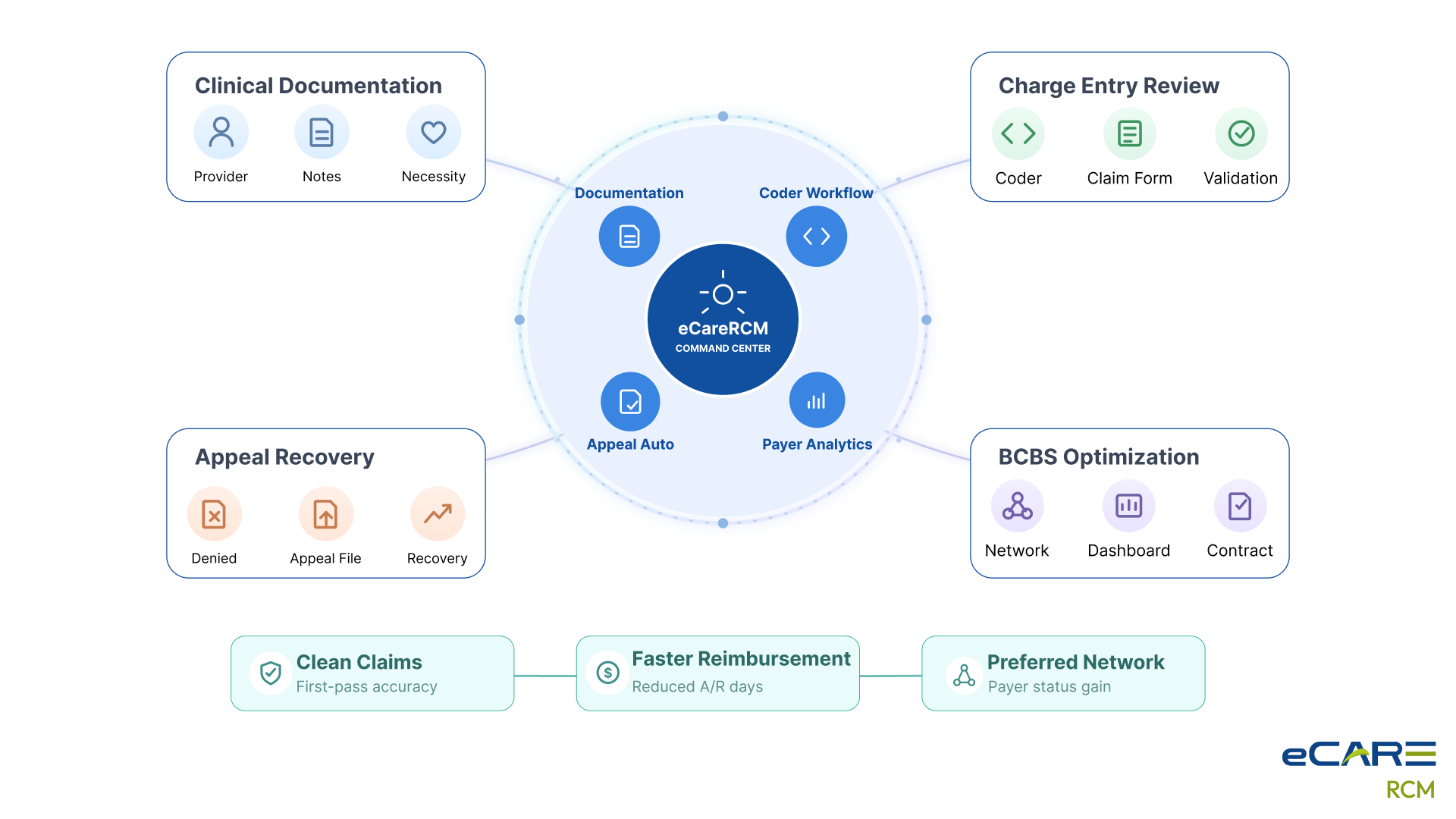
eCareRCM’s clinical-documentation-improvement module was selected because it addressed the root cause of Sussex’s denials, not the denial workflow itself, but the clinical documentation that preceded the denials.
The cath lab cases were being denied because the indications were inadequately documented at the encounter. The platform’s documentation-gap detection at the charge-entry stage flagged inadequate documentation before the claim went out, allowing the coder team to query the provider while the encounter was fresh.
The other capability that mattered was the systematic appeal workflow. Sussex’s appeal queue was backlogged for six weeks. eCareRCM’s appeal automation surfaced appeal-eligible denials and pre-populated appeal documentation, allowing the revenue-cycle team to file appeals within 72 hours of denial rather than 6 weeks.
The reference customer call that closed the procurement was with a cardiology practice in a different state that had been through a similar payer-pressure situation. The peer COO walked Sussex’s COO through what had worked: invest in clinical documentation improvement up front, expect the denial-rate movement to lag the documentation movement by 60 days, hold the line through the lag period, and the numbers will follow.
Value Delivered
The denial-rate movement happened in two phases. Documentation-quality scores moved within the first 60 days. Denial-rate movement followed in the next 60 days. By month four, the denial rate had moved from 11.2% to 7.1%. By month six, it was at 4.8%. By month nine, when the BCBS contract negotiation began, it was at 3.4%. The negotiation closed with improved terms rather than compressed ones.
- Denial rate dropped from 11.2% to 3.4% in 9 months — top-quartile in the BCBS network.
- Net collection rate lifted from 92% to 97.4%, exceeding the 96% specialty benchmark.
- Charge entry latency dropped from 3.1 days to 0.6 days through documentation-gap detection at the encounter.
- $2.8M recovered through systematic appeal cycles — appeals that previously would have aged out of the timely-filing window.
- $340K reduction in refund-queue exposure through improved upfront documentation that survived payer recoupment review.
Solution Provided
The deployment ran 7 months total — longer than typical because the work was as much about clinical documentation discipline as about RCM workflow. The COO understood the work as a clinical-operations engagement that happened to live in the revenue cycle, not the other way around.
Months 1–2: Cath Lab Documentation Reset
The cath lab was where the worst denial rate lived, so the work started there. eCareRCM’s clinical-documentation-improvement specialists (two CCDS-credentialed RNs) worked alongside Sussex’s cath lab cardiologists for six weeks. They surfaced specific documentation patterns that were producing denials — most often, indicating documentation that didn’t meet payer LCD requirements. The cardiologists initially pushed back; by week four, they had adapted to the new patterns. By week 6, cath lab denials had dropped 40%.
Months 2–3: GI Procedure Documentation Workflow
The GI procedure workflow came next. The documentation gaps were narrower but the volume was higher. The same clinical-documentation-improvement playbook was applied, adapted to GI-specific indications. By month 3, GI procedure denial rates had moved from 7% to 4%.
Months 3–4: Coder Workflow Migration
The coding team migrated to the eCareRCM workflow with documentation-gap detection live at charge entry. Coders could now query providers in real time when documentation was inadequate, rather than producing a denial-eligible claim and waiting 30 days for the payer rejection. Charge-entry latency dropped from 3.1 days to 0.6 days within the month.
Months 4–5: Appeal Workflow Activation
The appeal automation came online. The team worked down the 6-week appeal backlog within three weeks of activation. Appeal recovery rates for the previously-stuck claims came in at 71% — meaningfully higher than Sussex’s historical appeal recovery rate of 54%, because the appeals were now being filed within the time window when payer review was actually substantive.
Months 5–7: BCBS-Specific Workflow Tuning
The final phase tuned the workflow to BCBS-specific patterns ahead of the renegotiation. eCareRCM’s payer-relations team produced a BCBS-specific dashboard that Sussex’s COO could share during the renegotiation. The data positioned Sussex as a turnaround success story rather than a problem account.
Business Value
The BCBS contract negotiation closed in October 2025 — 12 months after the original payer review meeting. The new contract terms were materially better than the prior terms: a 4% reimbursement-rate lift, a tier-up on the BCBS performance bonus program, and inclusion in BCBS’s narrow-network product that Sussex had been excluded from. The COO’s first sentence to her partners after closing the negotiation was: “We were 12 months from losing this contract. We are now in their preferred network.”
What changed about Sussex’s payer posture
The denial-rate movement repositioned Sussex from a bottom-decile performer to a top-quartile one across not just BCBS but every major payer. Three other payer relationships have been renegotiated with improved terms in the 18 months following the engagement. The payer relationships have shifted from defensive to strategic.
The financial picture
The combined impact across reimbursement-rate improvements, denial reduction, and appeal recovery represents approximately $5.2M in annual incremental revenue against the pre-engagement baseline. The implementation cost was $540K. The recurring annual value is roughly 9x the implementation investment.
What changed about clinical documentation as a discipline
Documentation discipline at Sussex is now part of the clinical-leadership conversation, not a back-office quality issue. The medical director participates in monthly documentation-quality reviews. The clinical-documentation-improvement specialists have become a permanent function. The cath lab cardiologists have collectively expressed appreciation for the work — they understand that the documentation discipline is what is allowing the practice to negotiate from strength rather than weakness.
The COO’s summary line
“BCBS told us we were a problem. We treated the warning as an opportunity. Twelve months later, they were paying us more, and we were in their preferred network. The warning was the most valuable communication we ever received from a payer.”