Orthopedic Practice Cuts Prior Auth Time from 8 Days to 26 Hours

The practice manager was facing an issue with prior authorization, and the treatments were delayed. The orthopedic practice needed to address this issue quickly to save revenue and improve patient safety.
Business Challenges
Brian Tovar had been the practice manager at Capstone Orthopedic Group for six years. His wife, Maria, was scheduled for a total knee replacement in January 2025. The surgery was rescheduled in late December because the insurance’s prior authorization was still pending.
It was rescheduled again in February because the authorization was incomplete. By the third scheduling attempt in late February, Maria had been in significant pain for an additional 8 weeks. Brian printed the auth tracking history and brought it to the next Monday morning executive meeting.
The CEO of Capstone, Dr. Howard Phelan, had been hearing about prior authorization issues for two years. He had received the data points — 6.2 days average turnaround, 24% first-submission denial rate, two FTEs working full-time on auth tracking, and he had treated them as operational metrics. Looking at the spreadsheet Brian put on the table, with his own employee’s surgical case being delayed twice for reasons that should have been preventable, he understood the problem differently.
Capstone had 14 surgeons across 3 ASCs in the Southeast. Surgical case volumes were growing. Prior authorization was effectively the rate-limiter on how many cases could be scheduled per week.
The two FTEs on auth tracking were maxed out. The clinical-criteria documents from payers lived on individual hard drives, often months out of date. Peer-to-peer review cycles consumed surgeon time that should have been in the OR. The system was operationally untenable, and the patient impact had become personal.
- Prior auth averaged 6.2 days from request to decision; 11% of scheduled cases were rescheduled due to auth delays.
- The practice manager’s wife was rescheduled twice — the trigger that moved the issue from operational to executive priority.
- Two FTEs spent 100% of their time on auth tracking via spreadsheets and faxed payer forms; both were considering leaving for less stressful roles.
- First-submission denial rate sat at 24%, triggering frequent peer-to-peer review cycles that consumed surgeon time during clinic hours.
- Payer-specific clinical-criteria documents lived on staff hard drives and were often weeks or months out of date when needed.
Solution
Dr. Phelan’s procurement was unusual in that it was as much an HR exercise as a technology evaluation. He told Brian that the two FTEs on prior auth tracking would be deeply affected by any platform change — they were proud of the work they had been holding together, and any solution that bypassed their expertise would fail. The platform choice had to elevate their work, not replace it.
eCareRCM’s prior authorization module was selected after a working session at Capstone in which the two auth-tracking specialists, Janelle Brown and Rebecca Wickham, walked the eCareRCM deployment lead through their actual day. They showed him their spreadsheet. They showed him their physical binder of clinical criteria documents.
They showed him the workflow they had built for peer-to-peer scheduling. The deployment lead listened. At the end of the session, he proposed a configuration that respected their workflow and automated the most tedious parts of it. Janelle’s response: “If we had this platform, we could double our case volume without adding people.” That sentence closed the procurement.
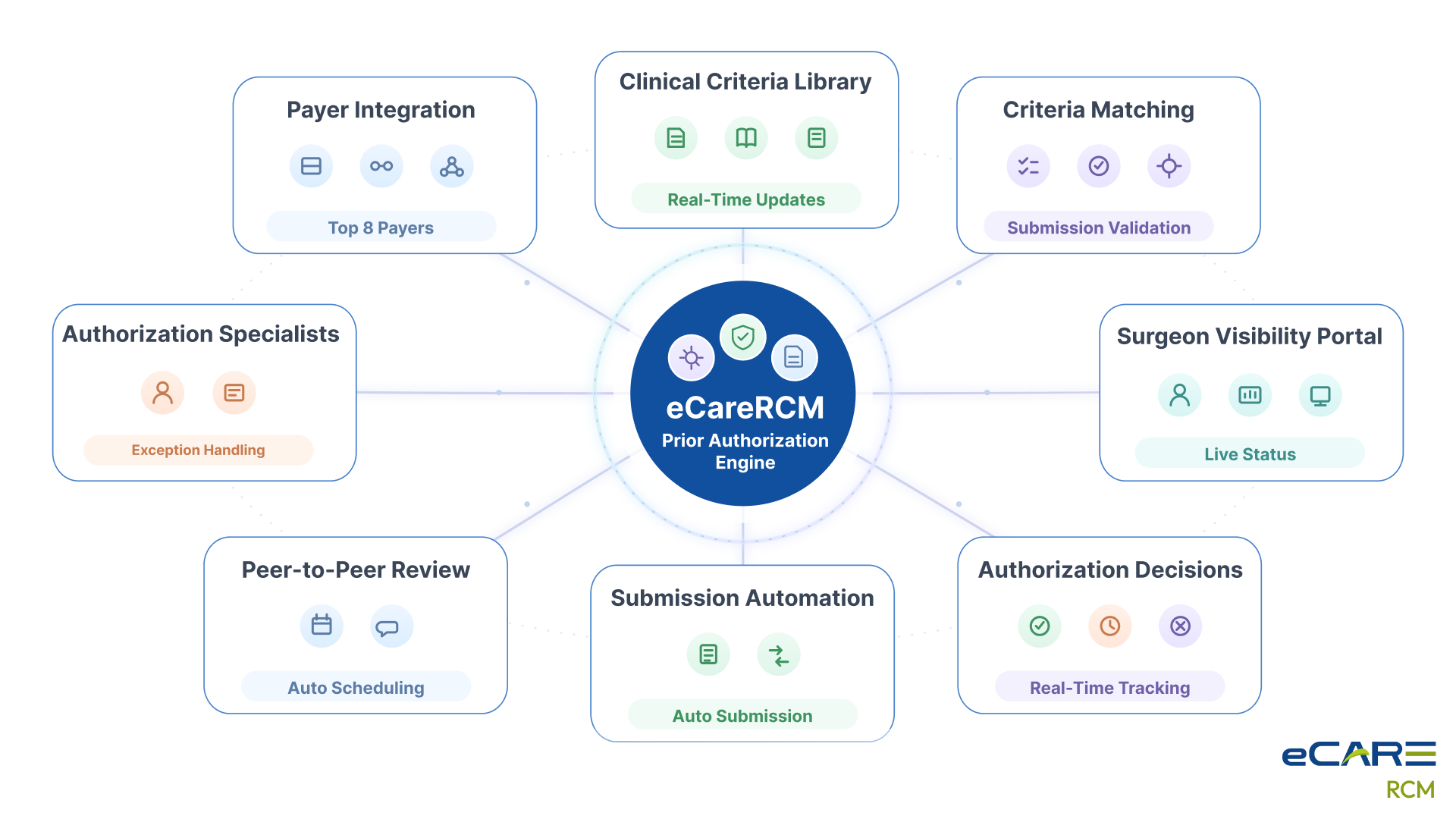
The selection also depended on a capability the other finalist couldn’t match: real-time payer clinical-criteria updates. eCareRCM maintained payer-specific criteria documents centrally and pushed updates automatically. Capstone’s staff would never again work from an outdated criteria document — a problem that had been driving denials systematically.
Value Delivered
The headline outcome was the turnaround time — from 6.2 days to under 24 hours. The outcome that mattered most to Dr. Phelan was that no patient at Capstone had a surgery rescheduled for auth-related reasons in the 18 months following deployment. Brian’s wife’s experience didn’t repeat for anyone.
- Prior authorization turnaround dropped from 6.2 days to under 24 hours; complex cases (spinal, total joint) were completed within 36 hours.
- 0% of cases rescheduled for auth delays in the 18 months post-deployment (vs 11% baseline).
- First-submission denial rate fell from 24% to 5% through automated clinical-criteria matching at submission.
- Auth-tracking effort dropped from 2 FTEs to 0.4 FTE; Janelle and Rebecca were both promoted into broader revenue-cycle roles.
- $1.4M preserved annual surgical revenue from on-time auth completion — the cases that previously would have slipped to the following quarters.
Solution Provided
The deployment ran 8 weeks — shorter than typical because the scope was narrower than a full RCM overhaul. The eCareRCM team treated it as a precision project, deploying only what was needed to solve the prior auth problem.
Weeks 1–2: Payer Integration and Criteria Library Loading
The first phase was technical: connecting eCareRCM’s platform to Capstone’s top 8 payers (representing 88% of surgical volume), loading the current clinical-criteria library, and validating that the automated criteria-matching at submission would produce results consistent with what Janelle and Rebecca would do manually. The validation phase took longer than the integration phase — Janelle ran roughly 200 historical cases through the platform and verified each decision against what she had done at the time.
Weeks 3–4: Workflow Migration for Janelle and Rebecca
The two auth-tracking specialists migrated to the new workflow in week 3 while running their existing spreadsheet in parallel. By week four, they had stopped using the spreadsheet. Their daily work was now reviewing automated submissions and handling exceptions — a different shape of work than the data-entry their day had been.
Weeks 4–6: Surgeon-Facing Status Visibility
The surgeons’ view of pending auth status went live in week four. For the first time, surgeons could see at a glance which of their upcoming cases had a status of authorization request, whether it is completed, pending, or denied. The clinic-day surgeon workflow changed within a week — surgeons stopped asking schedulers about auth status during clinic hours because the status was visible in their EHR view.
Weeks 6–8: The Two Most Complex Payers
The final phase brought up the two most complex payers — Anthem’s specialty orthopedic carve-out and a regional Medicaid managed-care plan — that required additional configuration around their specific peer-to-peer triggers. The configuration took eCareRCM’s deployment team a full week to get right.
What changed about Janelle and Rebecca’s careers
Within four months of go-live, Dr. Phelan promoted both Janelle and Rebecca. Janelle became Revenue Cycle Operations Coordinator with oversight of denial management broadly. Rebecca became Patient Access Lead with responsibility for the front-desk workflow that fed into prior auth. Both promotions came with meaningful raises. Both stayed at Capstone. The platform deployment had been Dr. Phelan’s vehicle for elevating two people whose work had been undervalued for years.
Business Value
Dr. Phelan presented the engagement results to Capstone’s partner board in summer 2025. He opened with the slide showing zero auth-related reschedules over the prior 18 months, and the financial slides came after.
What the practice’s clinical leadership values most
The patient impact is what the surgeons cite. Patients were experiencing surgical delays that were not driven by clinical necessity; they were driven by administrative friction that the practice had been carrying for years. Removing that friction has produced real clinical value: patients with degenerative conditions are receiving timely surgery, and post-op outcomes data have improved marginally as patients arrive in less prolonged deconditioning.
The financial picture
The $1.4M preserved annual surgical revenue is the headline financial number. The deferred staffing — Capstone would have needed to add two additional auth-tracking specialists to keep up with growing case volume, which represents another $180K in avoided cost. The total recurring annual value is approximately $1.6M against a $220K implementation investment.
What changed about the prior auth function
Prior auth at Capstone is now treated as a competitive advantage. The practice’s marketing materials specifically reference timely surgical scheduling, a claim that historically would have been risky to make. Referring physicians have noticed that primary care referrals have increased measurably as PCPs send patients to a practice where they know the auth will get done.
The line Brian uses when he talks about the engagement
“My wife’s surgery is what made this an executive priority. It shouldn’t have taken that. The data was on the table for two years. What changed wasn’t the data. What changed was that someone we knew was on the receiving end of the friction we’d been quietly tolerating.”