Multi-Specialty Group Drops Days in A/R from 52 to 31

A breach warning from the bank covenant revealed an AR problem that Sunrise Medical Partners had been carrying for two years. The leadership had 90 days to fix this issue, and that’s why they approached eCareRCM to increase their financial stability.
Business Challenges
The letter from the bank’s relationship manager arrived in the CFO’s inbox on a Wednesday. It was polite. It noted that Sunrise Medical Partners’ days-in-AR had exceeded 50 for two consecutive quarters and was now sitting at 52. The bank’s loan covenant required days-in-AR to remain below 45. The letter cited the covenant section. It asked for a remediation plan within 30 days and material progress within 90.
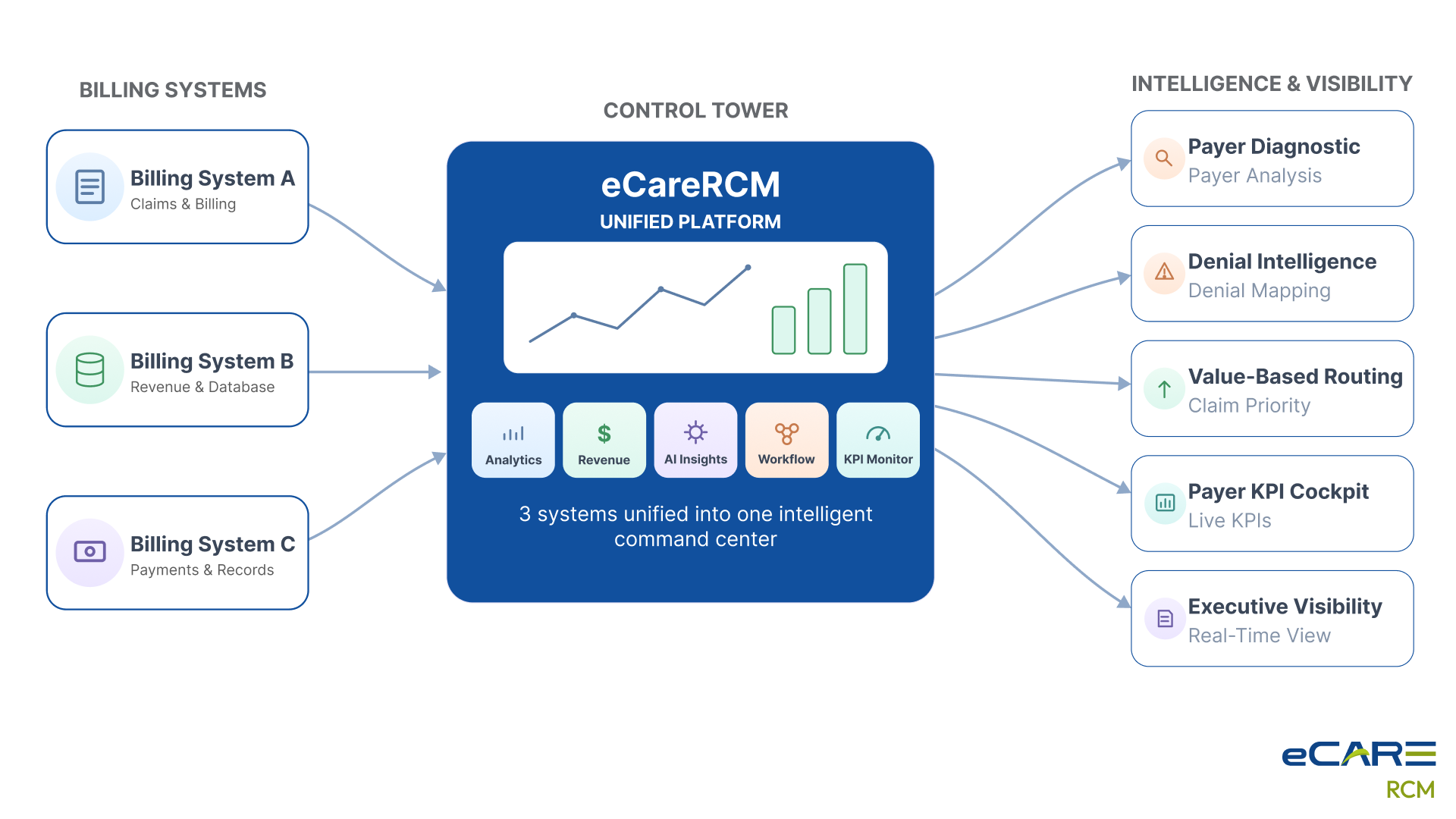
The CFO, Adam Hofstetter, had been in the role at Sunrise for 14 months. The AR problem predated him. Sunrise — an 80-provider multi-specialty practice with four locations across the Mid-Atlantic — had grown through acquisitions over a decade and had carried operational debt in the revenue cycle the entire time. Three different billing systems handled charge capture, claim scrubbing, and AR follow-up across the practice. Manual reconciliation between them took 11 days per month. The denial rate had drifted to 8.4% with no systematic root-cause categorization. AR follow-up worked oldest-first, missing $2M+ of high-value recent claims that should have been worked first.
Adam had been planning a revenue-cycle overhaul for the back half of the fiscal year. The bank letter accelerated the timeline by six months. He had 90 days to demonstrate movement.
- Bank covenant required days-in-AR below 45; Sunrise sat at 52 with a remediation deadline of 90 days.
- Three separate billing systems (charge capture, scrubbing, AR follow-up) required 11 days of manual reconciliation per month.
- Denial rate sat at 8.4% with no systematic root-cause categorization; the AR team didn’t know which payers were generating which denial types.
- AR follow-up worked oldest-first; $2M+ of high-value recent claims were sitting unworked while older small-balance claims consumed team capacity.
- The CFO had no real-time visibility into payer-specific performance — payer KPIs were assembled monthly during close.
Solution
Adam’s procurement was structured around the 90-day timeline. He had three days of demos. He talked to three reference customers. He met with two finalists in person. The decision criterion was specific: which vendor could commit to material days-in-AR movement within 60 days of contract signing?
eCareRCM’s deployment lead made a specific commitment. Within 60 days: payer-specific KPI cockpit live, denial root-cause categorization deployed, AR follow-up reprioritized by claim value rather than claim age. Days-in-AR would move 8–12 points within that window if the commitment was kept. Adam asked for the commitment in writing. He got it.
What also mattered: the eCareRCM team had three former multi-specialty CFOs on staff. Adam talked to one of them — a CFO who had been through a covenant-breach remediation at her prior practice. She walked Adam through what had worked and what hadn’t. The conversation wasn’t a sales call; it was a peer conversation about operational survival. That conversation closed the procurement.
Value Delivered
The 90-day timeline was met. Days-in-AR moved from 52 to 31. The bank’s relationship manager closed the covenant remediation review with a one-line note: “Material progress documented. Continued monitoring will revert to normal cycle.” Adam framed the outcome to the practice’s partners as “the most important quiet number we’ll ever see again.”
- Days-in-AR dropped from 52 to 31 within 90 days — exceeding the bank covenant threshold by 14 points.
- Denial rate fell from 8.4% to 3.1% as root-cause categorization surfaced systematic payer-specific patterns the team could remediate.
- $2.1M of high-value recent claims worked down in the first 45 days through reprioritized AR follow-up.
- Clean claim rate reached 96.8%, up from a 91% baseline.
- Real-time payer KPI cockpit live by week 6; Adam’s monthly close-cycle reporting time dropped from 11 days to 2.
Solution Provided
The deployment ran 90 days under intense pressure. Adam’s instruction to the eCareRCM team was specific: don’t try to fix everything. Fix the things that move the AR number first. The operational restructuring can come after the covenant compliance is documented.
Days 1–14: The Payer Diagnostic
The first two weeks weren’t about deployment — they were about diagnosis. eCareRCM’s analytics team ran a deep dive on Sunrise’s denial data, AR aging, and payer-mix performance. The output was a prioritized hit list: 11 specific payer-AR concentrations representing 64% of the AR opportunity. The list became the operating plan for the next 75 days.
Days 15–35: The AR Reprioritization Sprint
The AR follow-up team was retrained on value-weighted prioritization rather than age-based prioritization. The eCareRCM platform’s AR routing was deployed alongside. By day 35, the team had worked down $1.8M of high-value recent claims that had been sitting unworked. The team felt the change in their daily work; the cash flow showed it within the week.
Days 35–60: Denial Root-Cause Deployment
The denial categorization framework was deployed across all three billing systems via eCareRCM’s integration layer. For the first time, the denial data was unified and categorized. Eligibility-related denials accounted for 38% of the total — and were now addressable at the front-desk workflow level. The team built specific remediation playbooks per the top denial reason.
Days 60–90: The Payer KPI Cockpit and Close-Cycle Compression
The payer-specific KPI cockpit went live by week 9. Adam’s CFO team’s monthly close cycle moved from 11 days to 4 by the end of the deployment. The cockpit also let Adam see, for the first time, that two payers were systematically slow-paying clean claims — a posture that triggered a contract-renegotiation conversation in the following quarter.
What Adam credits as the turning-point operational change
The shift from age-based to value-based AR prioritization was a behavior change as much as a technology change. The AR team had been measured for years on the number of claims worked, not the dollar value of claims worked. Adam changed the team’s KPI structure during the deployment. The combination of the new workflow plus the new measurement is what unlocked the speed of the cash flow movement.
Business Value
Adam presented the 12-month engagement review to Sunrise’s partner board in late 2025. The presentation framed the engagement around what the practice had bought beyond covenant compliance.
What the practice avoided
A debt restructuring at Sunrise’s leverage level would have triggered partner-buyout negotiations and likely a forced sale of one of the four locations. The covenant compliance preserved the practice’s operating independence. That outcome is hard to quantify in a single number, but it is the largest single thing the engagement bought.
The recurring financial improvement
After the implementation of eCareRCM has been below 35 for 11 consecutive months. The denial rate reduction is also significant and saved Sunsire Medical Partners nearly $2.4M annually in recovered revenue and reduced rework costs. The return on investment is $4.1M against the $720K implementation investment.
What changed about the revenue cycle as a function
Adam created a Revenue Cycle Operations Director role six months after the engagement closed and promoted from within. The role reports to him directly and participates in payer-contract negotiations. The revenue cycle has moved from a back-office reporting function to a strategic operating discipline at Sunrise. The board now sees payer-specific KPIs in every quarterly review.
What Adam tells peer CFOs
“We had two years of accumulated revenue-cycle debt. We paid it down in 90 days because we had to. We could have paid it down anytime in the prior two years. What changed wasn’t the technology — what changed was the operational discipline that the technology made possible to execute against. The covenant letter was the gift.”